
Trailer Hitch 101: What Every Truck Owner Should Know Before Towing
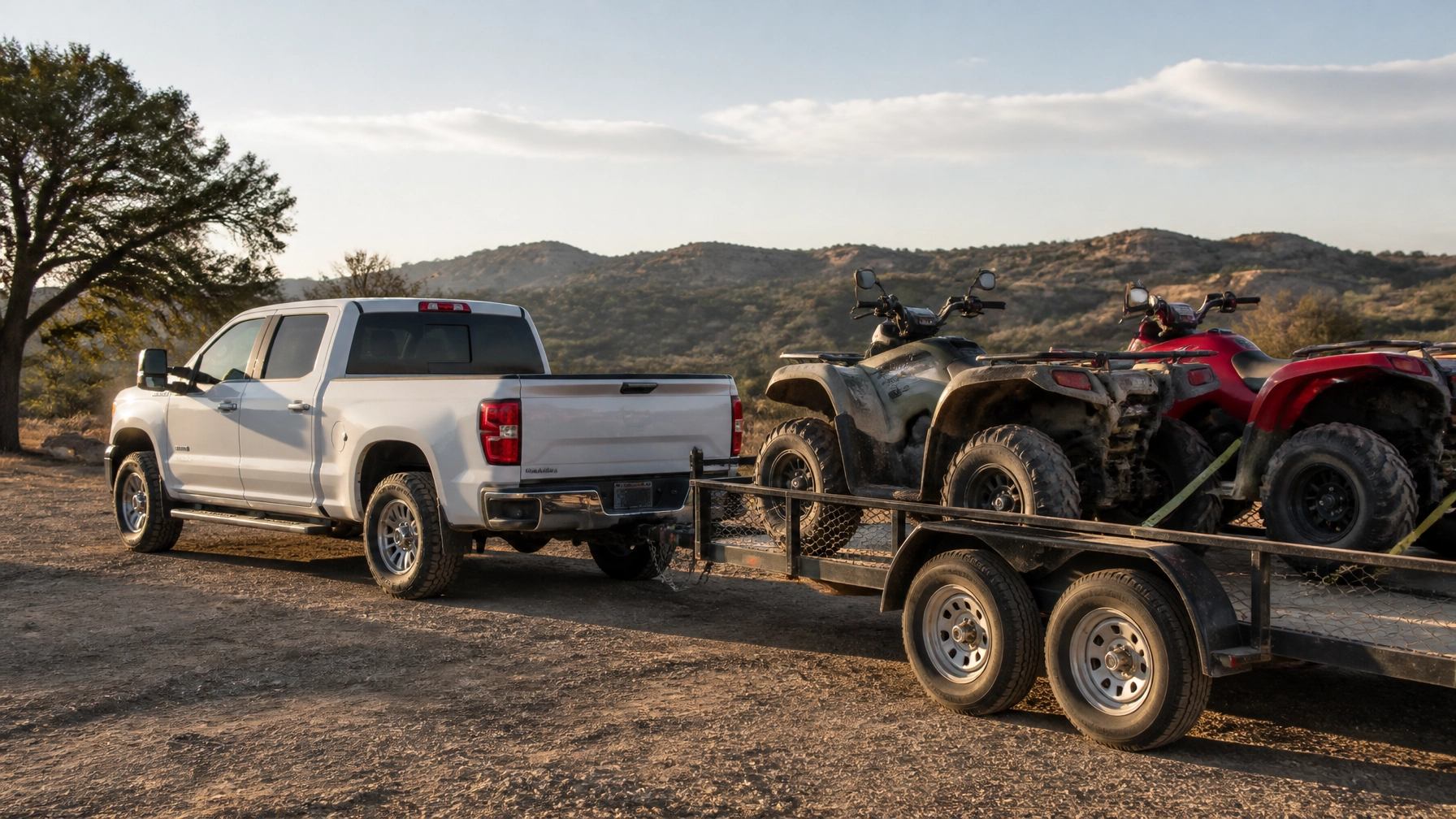
You’re halfway to the lake when the trailer starts swaying behind you. The steering feels light. The truck squats. Every bump sends the load moving farther side to side.
That is not the time to learn that your hitch, ball mount, or trailer brakes are mismatched.
Towing can be safe, steady, and straightforward when your equipment is set up correctly. But a trailer hitch is more than a piece of steel under your bumper. It is the connection between your truck, your trailer, and everything you are hauling.
Before you tow a boat, camper, equipment trailer, or your side-by-side, here’s what you need to know about trailer hitches, hitch classes, weight ratings, and towing safety.
What Does a Trailer Hitch Actually Do?
A trailer hitch attaches to your truck’s frame and gives you a secure connection point for a trailer or other truck accessories.
With a receiver hitch, you typically use:
- A receiver tube
- A hitch pin and clip
- A ball mount
- A hitch ball
- Safety chains
- Trailer wiring
- A trailer brake connection, when required
Think of the hitch as the foundation of a house. The ball mount, hitch ball, wiring, and safety chains all depend on it. If one part is undersized, damaged, or incorrectly installed, the entire towing system is limited.
That’s why the strongest-looking hitch does not automatically make your truck capable of pulling more. Your truck’s tow rating is the final word.
As explained in CURT’s towing guide, the safe capacity of your setup is limited by the lowest-rated component. That includes the vehicle, hitch, ball mount, hitch ball, trailer, axle, and accessories.
What Are the Main Trailer Hitch Classes?
Receiver hitches are generally divided into five classes. The class gives you a starting point, but it is not a substitute for checking the specific rating stamped on your hitch.
| Hitch class | Common receiver size | Typical gross trailer weight | Common use |
|---|---|---|---|
| Class 1 | 1¼ inches | Up to 2,000 pounds | Small utility trailers and bike racks |
| Class 2 | 1¼ inches | Up to 3,500 pounds | Small boats, campers, and utility trailers |
| Class 3 | 2 inches | Up to 8,000 pounds | SUVs, half-ton trucks, boats, and campers |
| Class 4 | 2 inches | Up to 10,000 pounds | Full-size trucks and heavier trailers |
| Class 5 | 2, 2½, or 3 inches | Up to 20,000 pounds | Heavy-duty and commercial towing |
These are common ranges, not guarantees. A Class 3 hitch on one vehicle may have different ratings from a Class 3 hitch on another.
Class 1 and Class 2 Hitches
These lighter-duty hitches are common on cars, crossovers, minivans, and smaller SUVs. They usually use a 1¼-inch receiver.
They are suitable for lighter loads, such as:
- Bike racks
- Cargo carriers
- Small landscaping trailers
- Small personal watercraft
- Lightweight utility trailers
They are generally not the right choice for a heavy camper, equipment trailer, or loaded boat.
Class 3 Hitches
Class 3 is one of the most common hitch classes on trucks and SUVs. It generally uses a 2-inch receiver and can handle a wide range of towing jobs.
This may include:
- Small to medium campers
- Utility trailers
- Boats
- ATVs and side-by-sides
- Landscaping equipment
Some Class 3 hitches can be used with a weight-distribution system, but you must verify that the specific hitch and vehicle allow it.
Class 4 Hitches
Class 4 hitches are built for heavier truck and SUV applications. They also commonly use a 2-inch receiver, but their weight ratings are higher than most Class 3 setups.
This is where you may start looking when towing larger travel trailers, heavy boats, or equipment. Still, the truck’s own towing and payload ratings come first.
Class 5 Hitches
Class 5 is the heavy hitter in the receiver-hitch world. These hitches may use 2-inch, 2½-inch, or larger receivers and are designed for heavy-duty trucks and serious towing work.
A Class 5 hitch can offer a high capacity, but that does not mean every truck can use its maximum rating. Your truck, trailer, axle, tires, brakes, and payload capacity must all agree.
How Do Weight Ratings Work?
Towing numbers can look like a pile of alphabet soup. Let’s put them in plain English.
Gross Trailer Weight
Gross Trailer Weight, or GTW, is the total weight of the trailer when loaded.
That means the trailer itself plus:
- Fuel
- Water
- Tools
- Cargo
- Camping gear
- ATVs
- Spare tires
- Anything else riding along
A trailer that weighs 4,000 pounds empty may weigh considerably more when you are ready to leave.
Tongue Weight
Tongue weight is the downward force placed on the hitch ball by the trailer.
For most bumper-pull trailers, tongue weight should generally fall around 10% to 15% of the loaded trailer weight.
For example, a 5,000-pound loaded trailer may place approximately 500 to 750 pounds on the hitch.
Too little tongue weight can cause trailer sway and fishtailing. Too much can make the rear of your truck squat, lighten the front axle, and reduce steering and braking control.
It is a little like carrying a heavy backpack. Put the weight in the right place and you can walk normally. Put too much weight at the wrong angle and your balance goes out the window.
GVWR and Payload
Your truck’s Gross Vehicle Weight Rating, or GVWR, is the maximum legal and safe weight of the truck itself. That includes:
- Passengers
- Fuel
- Tools
- Bed cargo
- Hitch equipment
- Trailer tongue weight
This is where many truck owners get caught. Your truck may have a high tow rating but not enough remaining payload for a heavy trailer tongue, passengers, and gear.
Check the driver’s door-jamb label and your owner’s manual. Do not rely on memory, a trim badge, or what a similar truck is rated to tow.
What Is the Lowest-Rated-Part Rule?
Here is the towing rule you cannot ignore:
Your entire setup is limited by the lowest-rated component.
Before you tow, compare the ratings for:
- Your truck’s maximum trailer weight
- Your truck’s maximum tongue weight
- The hitch receiver
- The ball mount
- The hitch ball
- The trailer coupler
- The trailer axle and tires
- Any weight-distribution hitch or accessory
If your hitch is rated for 10,000 pounds but your ball mount is rated for 6,000, your setup is limited to 6,000 pounds.
If your truck is rated for 7,500 pounds, installing a 12,000-pound hitch does not increase the truck’s capacity. It only gives you a stronger hitch attached to a vehicle that still has a lower limit.
Do You Need a Weight-Distribution Hitch?
A weight-distribution hitch uses spring bars to help spread trailer tongue weight across the truck and trailer axles. It can help keep the truck level and improve control when towing a heavier or longer bumper-pull trailer.
You may need one when:
- Your trailer is near the truck’s towing limit
- The rear of the truck drops noticeably when hitched
- The front end feels light
- The trailer manufacturer requires it
- Your truck or hitch manufacturer specifies it
A weight-distribution hitch is not a magic upgrade. It does not allow you to exceed your truck’s ratings. It must also be adjusted correctly for the trailer and load.
For very heavy trailers, you may need a gooseneck or fifth-wheel hitch mounted in the truck bed. These systems are designed for different trailer couplers and towing applications. They are not interchangeable with a standard receiver hitch.
What Should You Check Before Every Tow?
A pre-tow inspection takes a few minutes. A roadside failure can take hours. Worse, a loose connection or failed tire can put other drivers at risk.
Use this checklist every time.
Hardware
- Confirm the coupler matches the hitch ball size.
- Make sure the coupler is fully seated on the ball.
- Lock the coupler latch and install the safety pin.
- Insert the hitch pin through the receiver and ball mount.
- Secure the clip or hitch lock.
- Check the hitch for cracks, bends, excessive rust, or loose hardware.
Safety Chains
- Attach both chains to the proper points.
- Cross the chains beneath the coupler.
- Leave enough slack for turns.
- Keep the chains from dragging on the road.
Why cross the chains? If the coupler comes off the ball, crossed chains can help cradle it instead of letting the trailer drop completely.
Wiring and Brakes
- Plug in the trailer wiring.
- Test running lights.
- Test brake lights.
- Test turn signals.
- Check the electric brake controller.
- Confirm the breakaway cable is attached correctly if your trailer uses one.
Never assume the lights work because the plug is connected. Have someone stand behind the trailer while you test them.
Tires and Load
- Check truck and trailer tire pressure when cold.
- Inspect for cuts, bulges, exposed cords, or uneven wear.
- Check the spare tire.
- Secure loose cargo.
- Keep the load balanced.
- Keep heavy cargo low and positioned correctly.
- Confirm the trailer jack is fully raised.
Sounds, Smells, and Feelings: Red Flags to Watch For
Your truck will often warn you before a problem becomes a failure. Pay attention.
Sounds
- Clunking from the hitch area
- Repeated metal-on-metal knocking
- Squealing trailer tires
- Grinding wheel bearings
- Popping during turns
Smells
- Hot brakes
- Burning rubber
- Electrical insulation
- Overheated wheel bearings
Feelings
- Trailer sway
- Steering that feels unusually light
- Excessive rear-end squat
- A truck pulling to one side
- Brakes that feel weak or grabby
If something feels wrong, slow down safely and pull over. Do not try to “make it home” while a trailer is swaying, a tire is overheating, or a connection is clunking.
How Do You Choose the Right Hitch and Truck Accessories?
Start with the job, not the look.
Are you towing a small utility trailer once a year? Hauling a boat every weekend? Pulling a loaded equipment trailer for work? Carrying bikes, fuel cans, or an ATV?
Your answer determines the right combination of:
- Hitch class
- Receiver size
- Ball mount rise or drop
- Hitch ball diameter
- Wiring connector
- Brake controller
- Weight-distribution system
- Gooseneck or fifth-wheel equipment
- Locking pins and hitch accessories
The trailer should sit reasonably level when connected. A ball mount with the wrong rise or drop can affect handling and place extra stress on the hitch and trailer.
If you are unsure, do not guess. Bring your truck and trailer information to a shop that works with towing equipment. Trendsetters Customs is an authorized B&W dealer offering trailer hitches and truck accessories for real-world towing needs.

Get Your Truck Ready for the Road Ahead
The right hitch is about more than pulling weight. It is about control, stability, braking, and confidence when your trailer is loaded and the road gets rough.
At Trendsetters Customs in Weatherford, TX, we help you match your towing setup to your truck, trailer, and lifestyle. Whether you are hauling a work trailer, taking your boat to the water, or bringing your side-by-side to the trail, we can help you choose the right trailer hitches and truck accessories without the guesswork.
We are family-owned, veteran-owned, and woman-owned. We believe in honest recommendations, quality installation, and work that is ready for the next adventure.
Contact Trendsetters Customs or request an appointment before you hook up. Let’s get your truck set up right so you can tow with confidence and get on with the journey.
Related Posts
Bad Shocks or Just Rough Roads? 5 Signs Your Suspension Needs Repair
A rough patch can make any truck or car jolt. But if your vehicle keeps bouncing after the bump, dives when you brake, or feels loose in a turn, it may be more than the road. Worn shocks, struts, or…

The Truth About Leveling Kits: What They Can and Can’t Do for Your Truck
Ever walked out to your driveway, looked at your truck from the side, and wondered why it looks like it’s constantly sniffing the pavement? It’s called "rake." From the factory, most truck manufacturers build the back end higher than the…
Lift Kits 2026: Why “Smarter, Not Taller” Is the New Rule of the Trail
You’re headed down a rough Texas backroad when the trail suddenly gets mean. The front end drops into a rut. The steering feels loose. Your tires rub hard against the fenders. Then comes the sound every truck owner hates: a…